
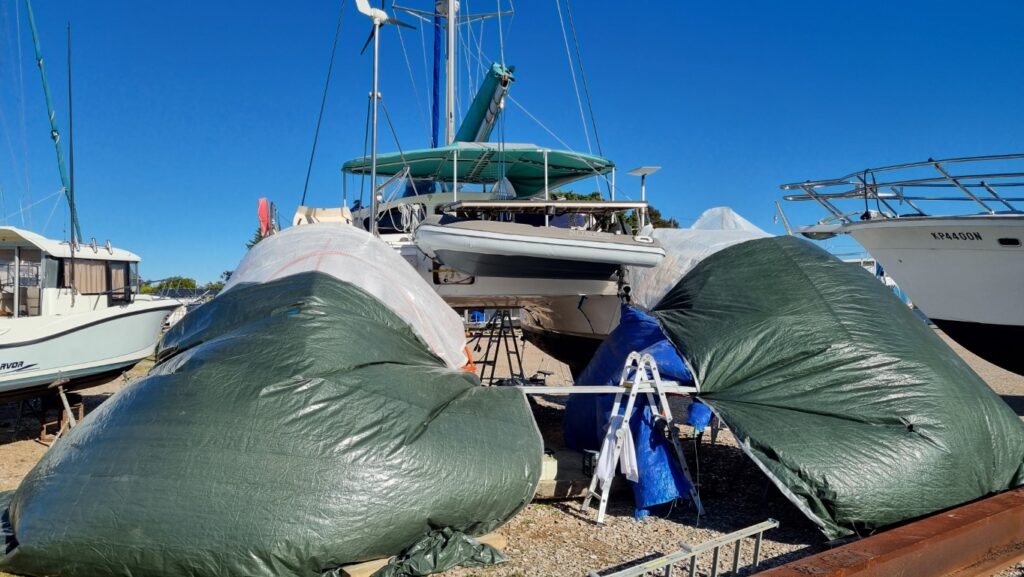
After a couple of days in Newport to sort ourselves out, we drove north to Oyster Cove to visit the yard and see how the boat was and where things were at with the work. It was pleasing to find that the boat was all well, no issues while we were away, batteries good, fridge/freezer still working, clean and dry inside. The yard kept an eye on her, but you never know after 4 months what might have happened. Happily just needed a good clean up outside.
First couple of days were just to catch up with Ryan the shipwright, Brett the mechanic and Jonathan the canvas guy, to see where we were at and to plan out the completion of the work over the next couple of weeks or so. I also took the opportunity to remove the flexible solar panels on the cabin top that had been annoying me for a long time. They hardly produced any power, were too hot to stand on in the sun and looked terrible. Easy enough to remove, but like so many “quick jobs” they revealed significant damage to the gelcoat underneath them where the heat and moisture had made a mess. So another task on the list – grind it back, refill and then apply a new non slip awlgrip coat.
The plan was to be there during the week working on the boat and then return to Newport (where we were using Ed and Alicia’s unit whilst they are away in Indonesia and Japan) for the weekends. Living on the boat in the yard is OK but fairly primitive and seriously cold at this time of year. Without the insulation of the water the temperature in the boat soon dropped to single figures at night. It also meant I could get a bunch of parts and material in Sydney where I know where everything is, then bring it up with me when I returned to the boat.
Deb had a bunch of things to do as well, not least the reprovision, but also spent a bit more time in Sydney, and one week went out to Mudgee to visit a close friend, rather than hang around the yard. She can tell that story.
It became a fairly comprehensive work list. When we bought the boat in Tahiti 3 years ago we had all the essential items done that were required (new standing rig, liferaft, chain, trampoline etc). However, that left a long list of other items that would become due once we were in a place where we had the time and access to the right professionals to get them done. After many miles and tropical conditions, a bit of TLC was overdue.
Without going into all the details, the main things have been a big cosmetic uplift to the hulls, repairing dings and scatches, completely refreshing the transoms, new gunwale strips, boot lines and a polish. She now looks a fantastic, like a new boat.
We also knew that the rudders needed some attention, showing signs of waterlogging. On inspection, it turned out that they were really messed up inside and the deal breaker was the obvious crevice corrosion in the shaft where it exited the blade. Not wanting them to drop off unannounced at sea, we decided to bight the bullet and have 2 new rudders and shafts built.
The other major job was to remove the engines and saildrives and have them fully serviced – new seals, pumps, damper plates, mounts, bellows as well as the normal change of filters, clean heat exchangers etc, cleaned up and repainted. In other words as good as reconditioned without going to a complete repower.
Whilst Brett was doing all that, I spent many back breaking (or folding more accurately) days removing all the old, very scruffy sound insulation from the engine bays. Then 2 pack flow coat the bilges before putting in smart new sound insulation, ready for the fit of the engines and SDs. With all new pipe work, exhaust mufflers and hoses the refitted units and the engine bays look fantastic. To me it is so important to have a spotless engine room. Apart from it being so much nicer to work in, more importantly any emerging issue, leak, rattle etc is very obvious straight away, avoiding it becoming a bigger problem from lack of detection.
I also had the hatches replaced so that now the whole set up is 100%.
The final big job was to have a set of new canvas awnings for the cockpit which will make it much more rainproof and also shaded when we eventually get back into the tropics! They look great and will transform the liveability of the cockpit.
Other than that, there were a ton of smaller jobs – hatches reseated, new headliners, saloon windows resealed, windlass removed and serviced, chain end for end, new bow roller that is much more robust and better suited to the anchor geometry.
I also undertook the task of redoing the antifoul. Not a fun job scrabbling around under the boat, first removing the grot then applying 2 coats of thick, relatively toxic paint. Simple enough with the right gear, but physically demanding. We could have had the yard do it, but with everything else happening my role was to do all the stuff that did not need a professional to do (and also to try to keep some of the costs down of course).
It meant many long days and sore body but ultimately very rewarding. The boat now looks fantastic and many things we have wanted to address as we lived aboard for 3 years now done. A very different boat from the one we bought!
I have to say that all the folk at the yard have been terrific. Mick and the team at Cover Marine were always helpful, welcoming and friendly. Ryan and his team did a great job, with a real attention to detail and a depth of experience that was very much appreciated. Again nothing was too much trouble and they project managed the work very effectively. Brett the mechanic and Jonathan who did the canvas work was also great to work with.
It was with some relief and also nervousness that we returned to the water. Great to be afloat again and out of the yard, but would the engines work as they should, were all the new throughulls secure, would the steering, the nav gear, the watermaker etc all work again? Apart from a dead engine start battery on the starboard side, it seemed all was well, and the following morning (with the tide) we set off back into Port Stephens Bay to spend a few days testing everything, cleaning up and also adjusting ourselves back to life on board.
Sadly, not all went to plan. We found that one of the saildrives had water in the leg, which meant that the seals were not working on the shaft. The only solution was to haulout again and get them fixed. Apart from the additional cost, this was very frustrating after so much hard work and anticipation. We also had to wait a week for the tides to be suitable to get back to the slip and come out of the water. It did give us time to get all the necessary parts, so that the job itself would only tale a few hours. We had noticed that the shaft had signs of wear from previous seals but judged that by using shims the seals could be positioned on a good part of the shaft. Bad call as it turns out. So we put in a new shaft and new seals, and happily this seems to done the job. Easy in hindsight to think we should have done that first time, but these parts are several $k so you think twice before sending the order.
At the end of the day, it is a boat, stuff happens and you deal with it. What matters now is that we have a great boat which looks very smart now and we will continue to enjoy every day we have the privilege to live this aquatic life.
Now we just need a weather window to head north and find some warmer weather!