
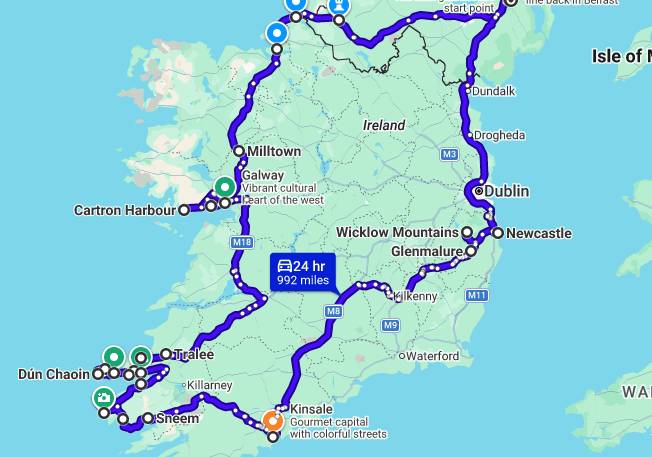
For such a small place it is surprising how many destinations you can fly to from Jersey and fortunately Belfast was included in those options. We were keen to rent a campervan through Camplify, which is a sort of Airbnb for campers. We have used it several times in Australia & never been disappointed and it operates in the UK which of course includes Northern Ireland but not its southern neighbour. Neither Bill or I had in fact been to Ireland before, which seems crazy given we lived in England for 27 years! However, those were the years of the ‘Troubles’ in Ireland and therefore not the safest tourist destination in those days.
So, off to Belfast to spend a couple of nights in the city before picking up the campervan. Although we didn’t have long we managed a trip to the Ulster museum before a great meal in Molly’s Yard the first evening. The next day we headed to the Titanic museum which was incredible. We must have spent 3 hours there, totally absorbed by what it had to offer. The museum is situated about 100m from the slipways where the Titanic was actually built. Within the museum is the historical perspective of the profitable industrial city of Belfast when the linen industry & shipbuilding were thriving in the late 19th century. There was a great deal of information about the construction of the ship as well as a ride which swoops you through a detailed reconstruction of the shipyard! There was also the human narrative around the launching of the ship, the passengers and their stories as well as explicit facts surrounding the disastrous impact of the Titanic with the iceberg leading to the ship plunging to the depths of the ocean. Well & truly worth a visit.
That afternoon we took a ‘Black Cab tour’ which are renown in Belfast. Our driver had first hand experience of the complex political situation that existed, (& still simmers beneath the surface), between the catholic & protestant populations in the west of Belfast. He was actually a cabbie during this time and was caught in crossfire sustaining a bullet wound to his leg. We had such an insightful and interesting tour centred around the Falls & Shankill roads – the respective enclaves of the Nationalists & Loyalists with a ‘Peace Wall’ in between – the gates of which still close at night. It was absolutely intriguing and we were blown away by the stories, his personal experiences, the murals illustrating the conflict and memorials that were meticulously maintained on both sides.
We picked up our campervan the following day. After an initial provision at the local supermarket we headed west towards Donegal for our first stop. We had decided to stay in a mix of quiet locations recommended by the park4night app, pub stays, (ie park in pub car park overnight for free as long as you eat/drink there) and traditional campsites.
The first night was spent just beyond Enniskillen in the countryside near Tully castle by the side of Lough Erne – a very peaceful place that we had to ourselves. The next day we crossed the border into county Donegal, in the Republic of Ireland to visit some well known surf spots – at least well known to Bill’s hippocampal surf data centre. Can’t say that it was pumping at Bundoran & Mullaghmore head, flat calm a more apt description but they were pretty spots despite the drizzle. We had a bit of a walk along the cliffs & discovered the Wishing Chair, where you sit & make a wish to the faeries that apparently inhabit these shores. Wishes were duly made & then we headed south towards Galway stopping for a lovely walk along the river at Milltown on the way.
That evening we found a perfect spot to park for the night in a place called Cartron Harbour, just within the Connemara national park. It was alongside a small harbour used by local fishermen, but very quiet whilst we were there – in fact we had the place to ourselves after about 6pm. Even enjoyed a bit of evening sunshine!
We decided not to take the campervan into Galway the following day as it is not a particularly camper friendly town. So we parked it not far out & caught the local bus. We hadn’t known that it was cash only, but we were saved by a kindly local who ‘instructed’ the bus driver to let us on for free! How kind! Galway was a fabulous city, full of life, music & colour. Loved it. We managed to dodge most of the rain walking around soaking in the atmosphere and energy of the place. It had a thriving handicraft market, a great museum & also a wonderful authentic traditional pub in the Latin Quarter called Tog Cóilí – recommended to us by our son, Wil, who had frequented that very establishment just a few weeks earlier. It was buzzing at lunchtime, it must be absolutely chockers in the evening when the music is on!
That evening we elected to do a ‘pub stay’ which is an arrangement several pubs have in Ireland whereby you can stay in their car park overnight provided you drink or eat in the pub. This particular pub, Pádraicins in Furbo specialised in seafood and we both enjoyed the most delicious bowl of seafood chowder with freshly baked soda bread. Yum – I became an expert food critic of this bowl of deliciousness whilst in Ireland.
The rain intensified the following day as we left Galway to head to the Dingle peninsula & unfortunately this was to set the weather pattern for the next 5 or 6 days of our trip. Nevertheless, every now & then the skies cleared as it did when we stumbled upon a Franciscan monastery on our way south not far from Limerick. Built in 1389, the Askeaton Franciscan Friary was dedicated to St Francis of Assisi and what remains is still quite impressive with a nearly intact cloister & many alter tombs to wander around. That evening we decided to stay in the Anchor caravan park on the northern side of the Dingle peninsula. It was pouring down so not much point in sightseeing, so instead we settled for a lovely long hot shower and early dinner!
The next day we headed for the lovely town of Dingle. We had to go the long way around, (via a place called Camp), rather than over the mountains via the Conor pass as the road was forbidden to larger vehicles due to the narrowness of the road and overhanging cliffs. Not that we would have seen much as the pass was totally embraced by cloud. After exploring Dingle town we decided to risk the weather and follow the Slea Head Drive, part of the Dingle Way. It is a 47km drive along the coastal route of the Wild Atlantic Way and it was pretty wild as the wind was howling & sea state pretty fierce as it bashed against the precipitous cliffs. We managed a couple of short walks bracing ourselves against the wind but loving the raw beauty of the surrounds. Eventually we made our way to a small parking spot for campervans close to the ruins of Minard castle where we spent a peaceful night lulled to sleep by the crashing waves on the nearby shore.
Not surprisingly, we woke up to rain the following day, but as the skies cleared a little we took the opportunity to drive up from Dingle to the summit of the Conor pass which is accessible to camper vans approaching from the south. It was unfortunately a fruitless journey as the summit, labelled as one of the ‘iconic viewpoints of the Wild Atlantic Way,’ was swathed in cloud with visibility little more than a few metres! So much for that idea! Doubling back we cut our losses & headed to Inch Beach for a brief walk along the sand that stretches for over 3 miles. I can imagine it is stunning in the sunshine, but in the drizzle the surf didn’t look very tempting, (kudos to the hardy folk in the water). Time just to enjoy the drive along the picturesque roads along the southern edge of the Dingle peninsula and around onto the ring of Kerry that we were to explore for the next couple of days. We spent the night parked on the hillside at Rossbeigh – a lovely peaceful spot with magnificent views across Dingle bay and east over Rossbeigh beach.
The following day was dedicated to exploring the Ring of Kerry. First stop on the tourist trail: the Kerry Bog Village! This was a collection of period thatched cottages which provided insight into the living conditions & culture of the famine years and peat industry of the 19th century. Each cottage was aligned to the particular occupation of the inhabitants with appropriate historical artefacts, sound effects & figurines. It was really quite insightful. Of particular interest was the history of the peat harvesting for fuel & power, which has now been totally upended. Commercial extraction is now banned & the EU are apparently funding the rehabilitation of huge areas of bogs in order to “rewet” dried-out bogs so they can absorb atmospheric carbon again! Fascinating!
Continuing on the beautiful costal route along the Iveragh peninsula, we were entranced by the scenic beauty of the mountains, fertile valleys, splattered with lakes & dotted with picturesque villages as well gorgeous coastal views. We took the Skellig ring, which branches off the Ring of Kerry, enjoying the winding narrow roads and wild Atlantic views for which it is well known. Stopping at the Kerry cliffs, we enjoyed the real atmosphere of the Atlantic coast – mist rolling in off the ocean and views obscured by cloud & drizzle. Having paid to enter, my vestigial but still operative Scottish genes, meant we were staying until the rain & cloud cleared sufficiently to get a view of the Skellig islands. Poor Bill, the things he has to put up with, as we traipsed from one lookout to the other backwards & forwards until finally it cleared sufficiently to glimpse the islands amongst the mist!
From there we drove over the mountains, (views obscured by cloud) to some pretty villages along the coast including Waterville, which draws some fame from being the preferred holiday location of Charlie Chaplin of all people! All in all it was a lovely drive and definitely my favourite of the whole Irish trip. We ended up in Sneem, (love the name), in a small camper van park, called Goosey Island, below the bridge overlooking the river. It was a lovely place – tourist central when we arrived but quiet & peaceful by evening as we wondered around to explore the village and enjoy a meal at one of the local pubs.
We had another good drive the next day heading south to Bantry then east through Skibbereen & Clonakilty to our final destination of Kinsale, a historical and very picturesque town on the River Bandon, well known as a safe harbour for both commercial & recreational vessels. We always seem to share an affinity with places where sailing boats are tranquilly anchored in beautiful surroundings! We parked next to the very impressive & expansive Charles fort – a 17th century military fortress with stunning views across the river. We headed into town, (about 40minutes along the Scilly walkway), to have a mooch around the colourful streets & check out the boats in the marina. All very pleasant and worthy of a longer stay than we had time for on our trip.
After exploring the fort and part of the coastal path that heads south away from Kinsale, the next day we continued our (almost) circumnavigation of Ireland through Cork and along the coast towards the Wicklow mountains. We had opted for another pub stay experience at Glenmalure lodge, a fabulous inn with gorgeous views at the base of the mountains. Having time on our hands, we drove to Glendalough, (meaning ‘valley of two lakes’), to explore the area. Apparently St Kevin set up an early Christian monastic settlement here in the 6th century and there are various well preserved ruins scattered about, although we were more intent on getting our leg muscles working. To that end, we hiked up a strenuous, steep track past the Poulanass waterfall & up 300m to the stunning Spinc ridge overlooking Glendalough. Gorgeous views of the lake and surrounding mountains and well worth it. After a cleansing ale & good meal at the Glenmalure Inn, we decided to return for the evening’s live music. We felt that we had missed out on the highly acclaimed Irish ‘craic’ – the social heartbeat of Ireland where everyone just has a bloody good time listening to music, stories or even just lively conversation. Sadly, what transpired was a lone musician with guitar singing covers of English songs. Not quite what we had in mind!
Eventually the sun shone bright & it was a stunning warm day, (the first of our trip), as we headed into the Wicklow Mountains National Park, the largest in Ireland. As we passed through Laragh, a nearby village, we had clearly stumbled on a significant running event. Well over a 100 red-faced, weary runners crossed our path as we headed into the hills. We later discovered that they were near to completing the Glendalough Lap of the Gap Marathon – Ireland’s highest road marathon that takes runners through the Wicklow mountains up to an elevation of 800m – must be gruelling. We followed the Wicklow Gap, a narrow winding road with views varying between barren moorlands intersected by streams & waterfalls and deep verdant glacial valleys with sheep draped on the slopes. Very definitely preferred driving it to running it for sure.
We planned to spend the final night in a campsite in the Mourne Mountains back in Northern Ireland so we wouldn’t have to travel far on our final day. We were looking forward to, at last, enjoying the sunshine and exploring the area at a leisurely pace. Alas, on the M50 as we skirted Dublin we experienced a blowout of one of the back tyres on the motorway. Fortunately, my very capable & calm husband navigated the van to the side, although there was no hard shoulder as we were on one of the elevated sections of the motorway. It was pretty scary as cars & trucks hurtled by at high speed, but much to my relief as Bill was on the phone to get help, the flashing blue lights of a motorcycle arrived with GARDA on the driver’s fluorescent yellow vest. I won’t go into all the details, but I would have to commend the efficiency & good humour of the police officer as well as the tow truck driver who rescued us. They were so helpful, friendly & both loved to tell us of their own connection to Australia, (seems that all Irish have been or have family there!). After fitting the spare, we had to replace the tyre, (which was in ribbons), all of which took a significant chunk of time in what was the sunniest day of the trip. It could have been worse – might have happened in the middle of nowhere in the Wicklow mountains.
Nevertheless, we reached the campsite and were able to finally sit outside and enjoy a sundowner in the early evening light with views across to the mountains. It wasn’t the end of our woes. We had noted that the other rear tyre was looking a bit tired but were reassured that the trip back to Belfast was not too far. We visited Newcastle, a pleasant coastal town for coffee & cake on the way back the following day. All proceeding well with about 15 miles to go when the vehicle shuddered and Bill declared ‘you know what that is don’t you?’ For sure, it was the unmistakable feeling of déjà vu & you’ve guessed it, the other tyre went. I was seriously losing my sense of humour at that point, but in the end the owners drove down from Belfast with more sturdy equipment to assist with changing the wheel, (Bill was unable to undo one of the bolts), and we did manage to get to the airport in time for our flight to Edinburgh that afternoon.
On reflection, we overall really enjoyed our trip around Ireland and wouldn’t hesitate to do it again. I think we would hope for slightly better weather: even though we anticipated rain, (not quite as much to be honest), it was the cool temperatures of 10 to 12 degrees most days that we didn’t expect. It just meant we spent more time inside the van than was ideal as campervan trips to us are all about enjoying the great outdoors. We really enjoyed the scenic beauty of Ireland whether on the coast or in the mountains and our encounters with the locals were always so positive and friendly.
So we’ll be back for sure some day…