
After spending such a fabulous time with Alice & Wil, it was time to look ahead to leaving French Polynesia and heading westward. There were a couple of reasons why we wanted to move reasonably quickly to Fiji (via Tonga) and leave the boat in a marina for a few weeks whilst we return to the UK.
Looking at the weather we knew we had a couple of weeks around Raiatea & Taha’a before making the short passage to Maupiti, about which we heard many great reports. It wasn’t hard to spend time revisiting some of our favourite anchorages, before completing the exit formalities at the Raiatea gendarmerie, which was a very straightforward process, (mainly because Bill is so organised with the paperwork).
We ended up leaving Taha’a at 1am so we would arrive at the pass into Maupiti early morning. It is a narrow pass facing the prevailing swell & wind, so we wanted to give ourselves plenty of time in case we needed to go to plan B, (sailing back upwind to Bora Bora). Fortunately, although a little tricky, the pass was fine & we motored into the lagoon, anchoring off the small ‘township’ of Vaiea.
Our first impression of Vaiea was that it resembled Rikitea in the Gambiers – very neat & tidy, luscious vegetation and a backdrop of formidable rock formations. Interestingly the population of Maupiti is 1200 – not much less than the Gambier islands, but because of the relative ease of getting to Maupiti by ferry, (including the fast ferry from Papeete), there are a lot more visitors here.
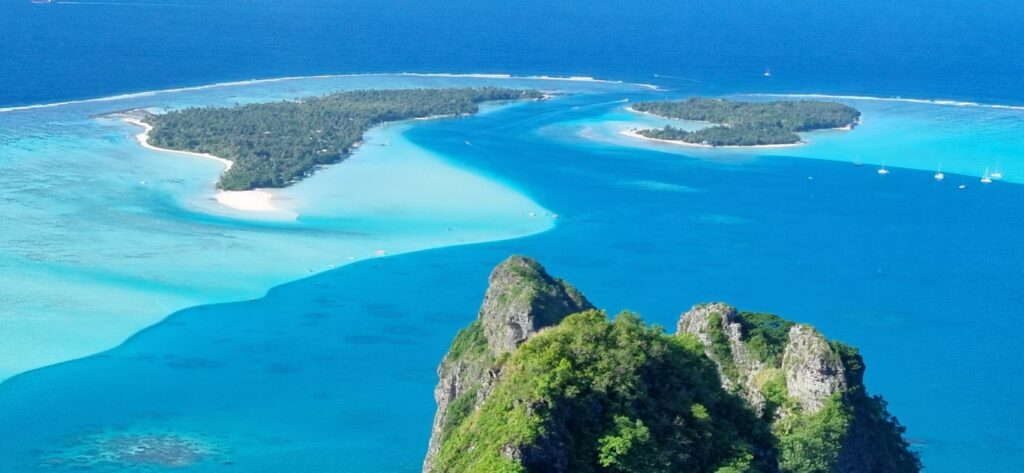
The following day was basked in bright sunshine & we opted to challenge our ‘land legs’ and take the hike to the top of Mount Teurafaatiu. It was certainly not for the faint-hearted with lots of scrambling up rocks, aided at times by ropes by which you could haul yourself up. Despite the effort, it was an incredibly rewarding endeavour, with the most magnificent views over the lagoon & outlying motus from the top. To be honest, I didn’t climb the last few boulders to the absolute top as my acrophobia got the better of me & I just couldn’t cope with clambering up a few rocks with a precipitous drop either side, just for an extra few metres. Bill did though!
After a couple of nights by the town, we headed just a few miles south to the sand flats just west of the entrance. This is where having a catamaran with a draft of 1.3m becomes particularly handy as we could drop the anchor into sand with really good holding, without worrying about wrapping the anchor around the bommies in the deeper areas. We had about 50cm of water below the keels – not much, but enough & fortunately we have got used to anchoring on shallow sandbanks during our stay in French Polynesia. We were tested a few nights later when we had squalls come through during the night of up to 36kts – we held steady although another boat dragged in the middle of the night, (not fun) & another got their chain entangled around a bommie.
There were several other travelling yachts anchored in the vicinity & one evening several of us tied our dinghies together, anchored on the sand flats and enjoyed sundowners together. We knew the names of the boats and had crossed paths previously, but it was the first time we met most in person. It is always good to share information & experiences and get an idea where most people are heading. The majority are travelling slowly west and planning to stop in the Cook Islands including Aitutaki & Niue, the most popular. So we didn’t identify any boat intending to travel directly to Tonga, which would have been good for the company.
The other highlight of Maupiti, for which it is renowned, was snorkeling with the manta rays. There was a specific manta cleaning station where the tourist boats stopped every morning between about 9&11am. We found if we went either side of this we had the mantas (we saw 4 in total) to ourselves! What a privilege! It really is absolutely awe inspiring to float on the surface within metres of these beautiful marine creatures, that glide effortlessly around you whilst the smaller fish dart in & out of their gills & cavernous mouths. And they are huge despite being reef mantas which are the smaller species, (the other being the pelagic mantas), with a wing span of between 3 & 4.5m! We never dived down, nor swam towards them, but I believe that they are quite inquisitive creatures and will come close to suss you out as we floated motionlessly above them. What a treat – we visited them 4 or 5 times whilst we were there. Here are some photos Deb took in the beautifully clear water.
There were also another few snorkeling places full of small & very nosy little fish, who were clearly fed by the tourist boats as they would swim right up to you & occasionally have a ‘nibble’!
Finally, it looked like a weather window was emerging for our 10day trip to Tonga and we up-anchored early in the morning and bounced our way over the knarly last 50-100m of the pass with breaking waves either side and 3.5kts of current beneath us. Certainly easier going out than going it – when we looked back having transited the pass, it certainly looked very scary if considering entry. The swell was a little higher when we left and even half a metre can make a huge difference to the conditions.
And so this marked the end of our time in French Polynesia. Over 2 years between Bill making the first trip to Tahiti to see the Mowzel Cat, buying it, fixing it & then enjoying it! We have had some great adventures in some very special places, my highlights being Amanu, Tahanea, the Gambiers & Moorea. We have experienced some beautiful lagoons, imposing peaks, palm fringed atolls & an abundance of marine life. Fantastic to have travelled with Kelani & very special to have hosted guests aboard as well. We have enjoyed the friendliness and hospitality of the Polynesian people and been inspired by their culture and rich traditions. But time to move on to the next chapter… Pics